

The FLNC Returns: Corsica, Autonomy and the Limits of French Centralism

By Marco De Leo
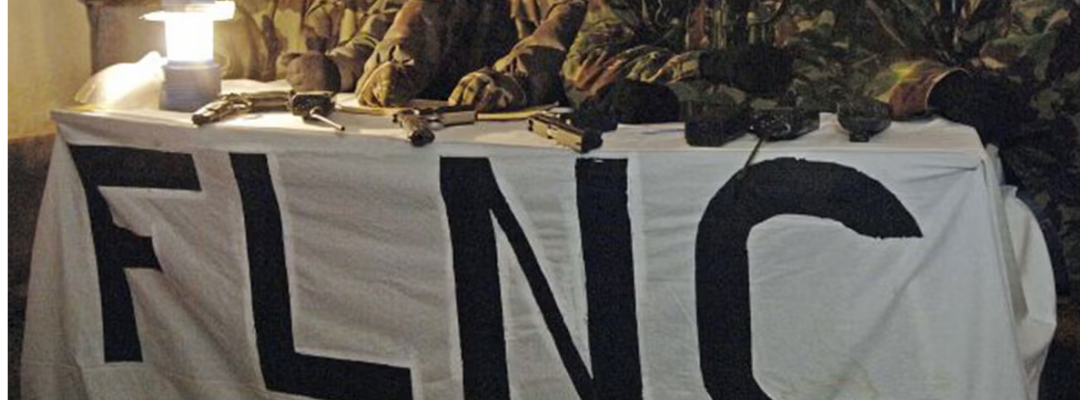
August 2026, Corsica, unknown location: In a closed room, a group of fifteen hooded men is gathering in front of a table. They are brandishing assault rifles and submachine guns, heavy weaponry that is difficult to come by in rural Europe. In front of the armed group, a delegation of hand-picked journalists from the local newspapers is seated, while listening to and recording a declaration from the hooded figures. The room is decorated with Corsican flags and four letters that are engraved in Corsican and French history: ‘F.L.N.C.’ To most, this acronym means little, but to the Corsicans it has marked 50 years of fights for political, cultural, linguistic, and historical recognition as a people. In that room, it is unmistakably obvious that the National Liberation Front of Corsica is giving a press conference and issuing a declaration to the French State.
The FLNC is a separatist paramilitary group with a long and troubled history, marked by ideological and personalistic schisms, internal infighting, and unclear relations with criminal groups active on the island. The group declared a demilitarisation process in 2014, leading to the institutionalisation of Corsican nationalist parties in local, national, and European institutions, but in that room, that same process has now been reversed.
But what does the FLNC want? And why are they releasing a communiqué to the press?
To understand the demands of the paramilitary group, we need to go back to 2022, when political prisoner and former FLNC militant, Yvan Colonna, was violently murdered under unclear circumstances by his inmate in the prison of Marseille where he was detained. Colonna was a popular figure in Corsica and among Corsican nationalist circles, and his death sparked large-scale riots on the island.
To defuse the situation and restore peace on the island, the French government promised a constitutional reform that would grant Corsica higher autonomy, something extremely rare for the highly centralised French state. The promise of the autonomy bill has been a strong priority for the regional assembly, but it has gathered discontent and doubt in Paris, where it is currently being discussed by the parliament, the president, and several other scrutinising state bodies. The bill of autonomy has faced several changes and will soon be debated in the Senate as bill N.782, with many critics pointing out that the region’s requests to Paris have been largely unmet, leaving Corsica with little regional legislative power, the total dismissal of Corsican as a co-official language for the island, and, most importantly, requiring the approval of the majority of residents of the region to fully implement the bill.
To the unattentive eye, this last detail may seem minor, almost formal, but it is one of the main points of tension between the central government and Corsicans. In fact, it means that to implement the autonomy bill, the law will be subject to a referendum of the inhabitants of the island, whether French, immigrants, or native Corsicans. This detail has gained increased importance, as the Corsicans have fought through democratic and armed means to safeguard their distinct linguistic, cultural, and economic identity. This identity, which is strongly tied to farming, has been disrupted since the 1950s by the relocation of former French-Algerians to the island through the expropriation of farming estates from the central government. Moreover, the French government refuses to release official statistics regarding the demographics of its territory, including overseas territories and departments, refusing to recognise different groups within its territory as distinct peoples or ethnic minorities. Instances of this tactic have been registered during the referendums for independence in New Caledonia, where the settled French population overtook the local Kanak people and blocked their independence initiative. This scenario is realistically replicable in the Corsican context, with many mainlanders settling on the island in second homes and tourism estates, reducing access for the local population and further increasing tensions between the wealthier mainlanders and the more impoverished Corsicans.
For this reason, the FLNC, especially the ‘Union des Combatants’ division, has outlined the problems with this bureaucratic process, addressing specifically non-Corsicans and the local politicians who have agreed to the limited autonomy bill. This may cause an increase in attacks by the FLNC towards tourist infrastructure and the second homes of French settlers. This would not be the first time: Since the assassination of Yvan Colonna, assisted by the silence of French institutions, the FLNC has already conducted several attacks. However, unlike other European armed separatist groups, the FLNC has distinguished itself by following fairly strict ethics in its armed operations, targeting speculative infrastructure on the island and rarely directly targeting people, allowing the group to maintain a more favourable image in front of the wider public. Despite the length of the conflict, which spans in its current form for at least 50 years, the number of victims has remained remarkably low, with the FLNC being the faction with the most losses, mostly due to internal infighting and purges. The length of the conflict has led the armed group to leave behind Marxist-inspired positions, instead acting as an armed pressure group in support of issues close to the native Corsicans against the infamously centralist French state, which leaves little leverage for smaller peripheral citizens. This pragmatic approach has proven fairly successful, and outlined a dual strategy for the Corsican autonomist movement. This is composed of an official institutional strategy, carried out by electing Corsican nationalist parties to government bodies that allow it, complemented by an armed pressure strategy which forces French institutions to take Corsican demands seriously and strengthens the position of autonomist positions that would otherwise be sidelined by the current French institutional apparatus.
Nonetheless, the FLNC’s return to arms should not be underestimated, and it places itself in the already unstable French political environment, which is also partially to blame for this development. Furthermore, as shown in the press conference, the FLNC is armed with M16-AR15s, Kalashnikov models, Armalites, and several other military-grade weapons, indicating a highly trained force with years of experience in asymmetrical warfare. The autonomy bill risks becoming a symbolic gesture that satisfies neither the Corsicans nor Paris, leaving most problems still present on the Mediterranean island unanswered. Future governments of the French Republic will have to navigate not only an increasingly problematic international environment, but also growing threats from within its territory, with the FLNC among the potentially most threatening. Whether the conflict will develop towards an escalation or a pacification will depend solely on the willingness and capacity of future French executives to provide answers regarding linguistic and cultural recognition of the Corsican people, and to address the structural economic grievances that placed the island of Pasquale Paoli at the periphery of the state, not only geographically, but also socially and politically.
