

Politics in the World Nomad Games

By Beatriz Santos Mayo
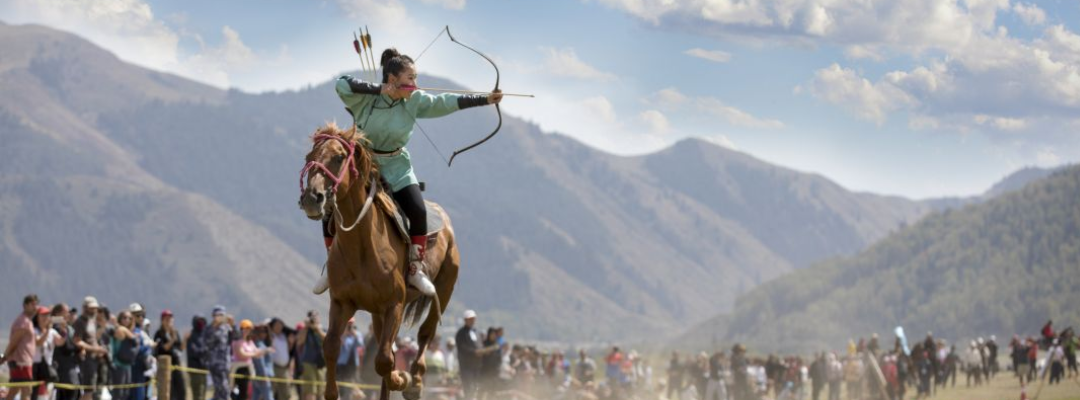
On 31 August 2026, the Bishkek Arena filled with 51,000 spectators and some of the world´s heads of state. The heads of state of Russia, Iran and Turkey, alongside India and Pakistan, took their seats in the stands as Kyrgyz President Sadyr Japarov declared the sixth World Nomad Games open.
However, this was not the only international event happening that weekend: Bishkek was also hosting the annual summit of the Shanghai Cooperation Organisation, and the guest list spoke for itself.
So, what exactly are the World Nomad Games, and what made Kyrgyzstan decide to create them in the first place? And perhaps more importantly, what are they really for?
A nation in search of itself
The Soviet Union had flattened much of what made Central Asian culture distinct, and the new Kyrgyz Republic had to rebuild its identity from scratch. The early years brought grand commemorative projects designed to tell the world that Kyrgyzstan had always existed and always mattered.
The idea that would become the World Nomad Games was first floated in Bishkek in 2007. For the Kyrgyz leadership, it quickly became something bigger than sports. As Azamat Zhamankulov, then deputy head of the Ministry of Culture, put it plainly: ‘We have to have a kind of annual brand-event about which tourists are aware and plan their trips accordingly. The World Nomad Games should become a similar brand-event.’ The political backing came in 2012, when President Atambayev presented the idea at the Summit of the Turkic Council. Kazakhstan, Azerbaijan, and Turkey backed it unanimously. Two years later, the first games were held on the shores of Issyk-Kul (Kyrgyzstan).
Historian Eric Hobsbawm wrote about “invented traditions” as practices that may look ancient but are often deliberately created or reshaped to serve present political goals. The World Nomad Games fit this idea well. The sports themselves have real roots in Central Asian history. But turning them into an international event and presenting yurts, horses, and eagles as part of a global brand was also a deliberate political choice.
The steppe as a stage
In 2026, the political frame around the games was more visible than ever. The decision to hold them on the same weekend as the SCO summit was not accidental.
Political analyst Temur Umarov doubted the leaders' schedules were ever fully in Japarov's hands. But the dates lined up, and Japarov used them. ‘The core audience this was aimed at,’ he said, ‘was Kyrgyz citizens.’ Political scientist Asel Doolotkeldieva agreed the week was about more than the presidential election coming in January 2027. ’It is meant to scale both the domestic and the external message,’ she said. ‘Kyrgyzstan now has a stronger state and a sharper identity.’
What brought the leaders to Bishkek was, as Al Jazeera put it, ‘the space to pursue their interests outside a Western-led framework.’ Putin told the summit the SCO had evolved into ‘one of the independent and influential centres of the emerging multipolar world.’ For Moscow, Central Asia had become what CFR President Michael Froman called ‘a kind of lifejacket.’ EU trade data showed Kyrgyz exports of dual-use goods to Russia running 1,200 per cent above pre-invasion levels.
With US sanctions and a naval blockade of the Strait of Hormuz strangling its economy, President Pezeshkian used the summit to keep diplomacy with Washington alive on Tehran's terms, calling on the US to return to the commitments it had agreed to under the Islamabad memorandum of understanding. China was the thread running through all of it, with Xi and Putin reaffirming their no-limits partnership on the sidelines, while Beijing made clear it would not allow Washington to dictate the terms of its engagement with Iran.
However, the SCO is not a unified anti-Western bloc. Its members have competing interests and, in some cases, deep disagreements. But the countries that do not agree on everything can still agree that they want room to manoeuvre. For a small landlocked country that cannot afford to close any door, hosting both the games and the summit in the same week was not a coincidence but a diplomatic opportunity.
