

Serbia's Two Funerals: for a War Criminal, and for Its EU Bid
By Marianne Bruneton
Ratko Mladić died on 27 August 2026 in a UN detention centre in The Hague, where he was serving a life sentence. He spent sixteen years hiding before he was arrested and sent to the International Criminal Tribunal for the former Yugoslavia (ICTY) in 2011. He was convicted in 2017, and his last appeal was rejected in 2021.
As commander of the Army of Republika Srpska, he led the siege of Sarajevo and the Srebrenica genocide in July 1995, where more than 8,000 Bosniak Muslim men and boys were killed. It remains the worst massacre on European soil since 1945. These crimes were part of a wider campaign of ethnic cleansing against Bosniak Muslim and Croat civilians across Bosnia and Herzegovina, in which an estimated 20,000 to 50,000 women were raped, alongside sieges, detention camps, and forced displacement. In total, the Bosnian War killed more than 100,000 people.
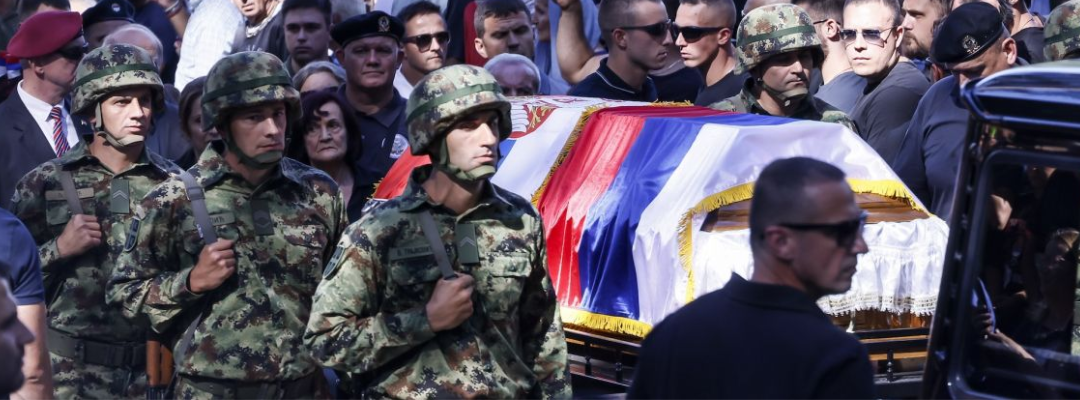
None of this history was in question on 7 September, when his body was laid in St. Luke's Church in Belgrade before an Orthodox funeral and burial at Topčider Cemetery. In fact, not only Serbian ministers attended, and soldiers carried his coffin, wrapped in the national flag, but also Russia's ambassador was among the others at the ceremony. Tens of thousands of ordinary Serbs came, many treating a convicted war criminal as a national hero. It was in this context, a state clearly organising honours for a man responsible for a genocide, that European Commission President Ursula von der Leyen and European Council President António Costa called it 'shocking.' They pointed out that Mladić died still convicted of genocide and crimes against humanity. A few days before the funeral, EU Enlargement Commissioner Marta Kos had already cancelled her own trip to Belgrade, which was meant to include the BELTALKS economic forum. She said the 'glorification' of Mladić's death went against the values Serbia's EU path is supposed to be built on.
The Repression of the Funeral Hid
The funeral made the headlines. However, at the same time, two separate findings point to the same problem. Indeed, Serbia has been using the tools of a security state against the citizens demanding accountability and transparency from it.
The first is spyware. Just before the funeral, 29 members of the European Parliament, from five political groups, wrote to von der Leyen and Kos asking them to freeze all pre-accession payments to Serbia. Their reason had nothing to do with Mladić. It was reported that Serbian authorities had used spyware against student protest leaders, activists, and opposition politicians, the same protest movement that had spent almost two years demanding justice for the Novi Sad railway station collapse.
The second is a weapon. After the '15 for 15' rally on 15 March 2025, when somewhere between 100,000 and 325,000 people marched in Belgrade to mark the anniversary of the 16 deaths in Novi Sad, the European Court of Human Rights issued an emergency order on 29 April 2025. It regarded claims that the Serbian police had used a sonic weapon to control the protestors. The Court told the government to stop, but Serbia denied using one. Since then, nothing has followed up.
Together, these two facts- spyware against the movement's leaders and an unresolved sonic weapon claim against ordinary protesters fighting for their rights- are not separate incidents. They, in fact, form a pattern: the same state that gave Mladić's coffin a military escort through Belgrade has also been watching, and very possibly using force against the citizens who forced Prime Minister Miloš Vučević to resign in January 2025 and pushed President Vučić to call the early election now set for 25 October. Serbia opened EU membership talks in January 2014. Nevertheless, it has not opened a new negotiating chapter since December 2021, and in July 2026, eight EU countries blocked a new group of chapters over exactly this kind of backlash on the rule of law. Ukraine and Moldova, both of which started their bids years after Serbia, have since moved ahead of it. The funeral was the moment Brussels finally started to realise the depth of the issue. The spyware and the sonic weapon may be the reasons it finally chooses to act upon it.
