

No Country for Far Right Politics

By Jokin de Carlos-Sola
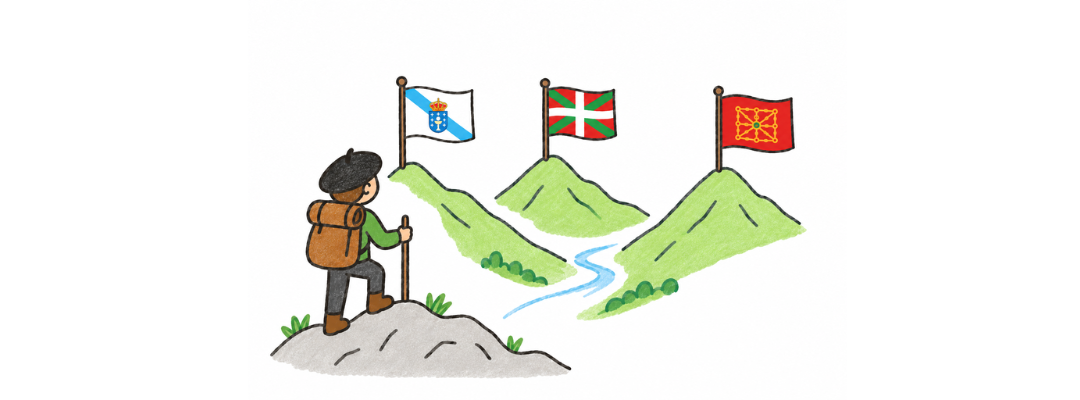
While the rest of Europe has seen massive growth of far-right politics in Europe, at both the national and regional levels, three regions in Spain break this trend: Galicia, Navarre and the Basque Country. These are regions characterised by rural areas and a strong sense of identity, and yet their populations still to this day reject the ideas that far-right politicians offer.
Across the EU, far-right and right-wing populist parties have become a significant part of national politics. At the regional level, the picture is much the same. In most European regions, parties of the far right have established a meaningful electoral presence. There are, however, three notable exceptions: Galicia, the Basque Country and Navarre.
In Galicia, the far right has failed to enter the regional parliament. In the 2024 election, VOX was the only far-right party running candidates, receiving just 2.5 per cent of the vote, well below the 5 per cent threshold. Recent polling has continued to place the party below that threshold, at around 3 per cent. In the Basque Country and Navarre, VOX has managed to win seats, but only narrowly, receiving around 2 per cent in the Basque Country and 4 per cent in Navarre, due to the fact that the Basque Country has no threshold and Navarre has only 3 per cent.
One possible explanation for these exceptions is the strong regional identity found in these territories. But regionalism alone cannot explain the difference. Catalonia has an equally powerful regional identity, yet it has seen the growth of both VOX and Aliança Catalana, a far-right Catalan nationalist party. VOX polls at around 10 per cent in Catalonia, while Aliança Catalana has at times polled above 16 per cent. Elsewhere in Europe, regions with strong identities such as Veneto, Flanders, Bavaria and Scotland have also experienced significant support for right-wing or far-right parties.
So why are Galicia, the Basque Country and Navarre different?
At first glance, their political cultures might seem fertile ground for the far right. All three have significant rural populations, strong local traditions and a long history of political scepticism towards distant capitals. Yet these characteristics have produced a very different political outcome.
Why Galicia?
There are two main reasons why the far right has struggled in Galicia.
The first is the dominance of the conservative People's Party (PP). Galician politics has been controlled by the PP for decades, often with large majorities. But the Galician PP has developed a somewhat distinct political identity. Alongside traditional conservatism, it has defended Galician culture, language and regional interests, making it different from the more explicitly Spanish-national focus of parts of the wider PP. This leaves little obvious space for a competing right-wing populist party. A voter seeking conservative and managerial government already has an established option. Opposition to the political establishment, meanwhile, has historically come more from the left.
The second factor is Galician nationalism. Unlike nationalism in some other European regions, its main political expression has historically been on the left. The Galician Nationalist Bloc (BNG) has become the principal vehicle for Galician nationalism and currently sits within the European left. The legacy of Francoism helps explain this. Franco's dictatorship promoted centralisation and suppressed regional languages and identities. As a result, defending Galician identity became closely associated with opposition to authoritarianism and the political left. VOX, on the other hand, unlike other far-right parties, is strongly identified by its centralising ideas and opposition to regionalism. Demographics also matter: Galicia has experienced relatively little immigration compared with many other European regions, particularly in rural areas. Its major demographic concern has traditionally been the opposite: young people leaving.
For a rural Galician voter, then, many of the issues normally exploited by the far right are already represented elsewhere. If you want conservative government, there is the PP. If you want to defend Galician language and identity, there is the BNG. There is relatively little political space left for the far right.
Why the Basque Country and Navarre?
The Basque Country and Navarre have a different, but related, political history. For decades, politics in both territories was shaped by communal conflict and violence. The separatist paramilitary and terrorist group Euskadi Ta Askatasuna (Basque Fatherland and Freedom), or ETA, carried out a sustained campaign of terrorism against the Spanish state, security forces and political opponents. At the same time, the 1970s and 1980s saw serious cases of police violence and torture, alongside attacks by Spanish far-right and unionist paramilitary groups, including the Batallón Vasco Español and GAL.
This history left a deep mark on political identity. In the Basque Country, the Basque Nationalist Party (PNV) has been the dominant political force since the restoration of democracy and has also maintained a strong influence in Madrid politics. Founded in the nineteenth century as a Christian and nationalist movement, the party evolved considerably over time into a moderate, pro-European conservative nationalist force.
Navarre developed differently. Its population has long been divided between Basque nationalists and Spanish unionists. From 1991 to 2015, the conservative UPN dominated regional politics, frequently positioning itself against Basque nationalism and aspects of Basque cultural identity. The end of ETA's armed campaign in 2011 gradually changed this political landscape. Since then, both the Basque Country and Navarre have seen governments built around coalitions of moderate nationalists and left-wing unionists.
This creates a difficult environment for VOX. Its strongly centralist approach to Spain and confrontational rhetoric can appear out of step with societies that have spent decades dealing with political violence and polarisation. In a region where reducing communal tensions has become an important part of the post-conflict political consensus, there is limited space for a party perceived as reopening those divisions.
Basque nationalism also presents another obstacle to the far right. As in Galicia, it has historically developed through both centrist and left-wing traditions rather than producing a major far-right movement. History is important here: During the Spanish Civil War, Basque President José Antonio Aguirre and the PNV-led Basque government opposed Franco. In exile, Aguirre and the Basque government supported the Allied cause during the Second World War. Aguirre was a conservative Catholic and a Basque nationalist, but also an anti-fascist and supporter of European integration. That legacy still matters. For many Basque conservatives, nationalism, Catholicism and Europeanism have historically been compatible without requiring a turn towards far-right or Eurosceptic politics.
At the same time, the Basque left has developed a strong cultural presence of its own. Basque nationalism is expressed not only through political parties but through music, student organisations, football supporter groups and wider civil society. In many of these spaces, cultural identity is combined with left-wing economics, such as defence of public housing and investment in green rural development, and an emphasis on an inclusive society.
The result is an unusual political landscape. Across much of Europe, rural conservatism and regional identity have helped create space for the far right. In Galicia, the Basque Country and Navarre, those same characteristics have instead been channelled through established conservative, regionalist and left-wing nationalist movements. This is very significant as Basque and Navarrese people on average are more concerned about immigration than other regions of the Spanish state, yet that does not translate into support for VOX or a Basque far right party.
Conclusion
The lesson from Galicia, the Basque Country and Navarre is not that regional identity or rural conservatism automatically protect societies from the far right. Rather, what matters is whether mainstream political movements already provide credible ways for voters to express those identities and concerns.
In all three regions, conservative or nationalist politics have historically been able to exist without being tied to hostility towards minorities, rejection of European integration or aggressive centralisation. Regional identity has therefore not been left for the far right to claim. At the same time, established political parties have incorporated concerns over culture, language, demographic decline and local autonomy rather than treating them as fringe issues.
There is also an important lesson about political competition. Where mainstream parties offer credible alternatives on questions of identity, governance and economic security, voters have less incentive to turn to parties whose central appeal is opposition to the political establishment.
This does not mean that other European regions can simply reproduce the Galician, Basque or Navarrese experience. Their histories are unique. But policymakers can learn from the underlying principle: address legitimate concerns before political entrepreneurs turn them into grievances, and allow regional identity to coexist with pluralism, Europeanism and democratic institutions.
