

Shaping Europe One Dialogue at a Time: How Young People Can Have Their Say in the EU
By Gloria Aleotti
Being young is not easy, especially in the current social, economic and geopolitical environment. Young people can feel lost in a world where everything seems to be a challenge, and nobody can give them the right instructions to solve the problems they face. The rise of artificial intelligence, an increasing housing crisis, the struggle to enter the job market – even the most basic aspects of everyday life can become a tough endeavour. And, what’s more, young people are too rarely at the centre of a political debate that seems to have other priorities. Yet, there is one thing that cannot be taken from them: their voice. And, luckily enough, there are tools in place within the EU that allow them to make themselves heard.
The Broader Framework: An Overview of the EU Youth Strategy (EUYS)
In the EU, youth policy is primarily a responsibility of the Member States. According to Article 165(2) of the Treaty on the Functioning of the European Union (TFEU), EU action in the field is aimed at ‘encouraging the development of youth exchanges and of exchanges of socio-educational instructors, and encouraging the participation of young people in democratic life in Europe’. Nonetheless, Member States have cooperated in the youth field since 2002. This cooperation framework has since evolved into what is now known as the EU Youth Strategy, the current framework covering the period from 2019 to 2027.
At its core, the Strategy seeks to ensure that more young people have access to the opportunities they need to shape their future and thrive in life. In doing so, it places particular emphasis on reaching young people from different backgrounds and addressing the social and economic barriers that can limit their opportunities, including youth poverty and social exclusion. More broadly, the framework aims to improve young people’s lives across Europe by promoting greater and more equal opportunities for all.
Focusing on the structure, the EUYS is built around three main pillars: Engage, Connect and Empower.
‘Engage’ focuses on encouraging young people to take an active role in civic and democratic life. A key tool in this area, which is going to be analysed more in depth later on, is the EU Youth Dialogue, which creates a space for structured exchanges between young people, youth organisations and policymakers at different levels.
‘Connect’, on the other hand, is about bringing young people together across Europe and beyond. Through volunteering, learning mobility and opportunities to experience different cultures (mainly through the Erasmus+ and European Solidarity Corps programmes), the Strategy aims to foster solidarity, intercultural understanding and a stronger sense of connection.
Finally, ‘Empower’ focuses on giving young people the tools and support they need to become active actors in their communities and in society at large. This includes strengthening youth work and recognising its role in supporting young people’s personal and social development.
Another point worth highlighting is that the 2019-2027 framework has also led to the creation of new roles and mechanisms aimed at strengthening young people’s involvement in EU policymaking. In June 2021, the European Commission appointed its first EU Youth Coordinator, tasked with promoting cross-sectoral cooperation on youth issues within the Commission. More recently, in July 2025, the Commission launched the President’s Youth Advisory Board, giving young people a more direct role in advising on key EU initiatives, including climate action, digital transformation and social inclusion.
There is no doubt that the EU Youth Strategy provides a comprehensive framework with the potential to empower young people, helping them to find their path and encouraging them to take an active role in shaping the future they will inherit. Yet, despite the progress made, countless young people still feel left at the margins, while many of the issues affecting their lives struggle to take the centre stage in the political debate. In this context, the answer is to speak up, because only in this way will their voices eventually be too loud to be ignored. This is where the EU Youth Dialogue comes in.
Giving Young People A Voice: How the EU Youth Dialogue Can Give Young People a Seat at the Table
Let’s start with definitions. The EU Youth Dialogue is, in simple terms, a mechanism for dialogue between young people, youth organisations and decision-makers, and it is established within the framework of the EU Youth Strategy. As for its purpose, it aims to ensure that all views, needs and concerns of young people are not only expressed, but also taken into account when shaping policies that affect their lives and their future.
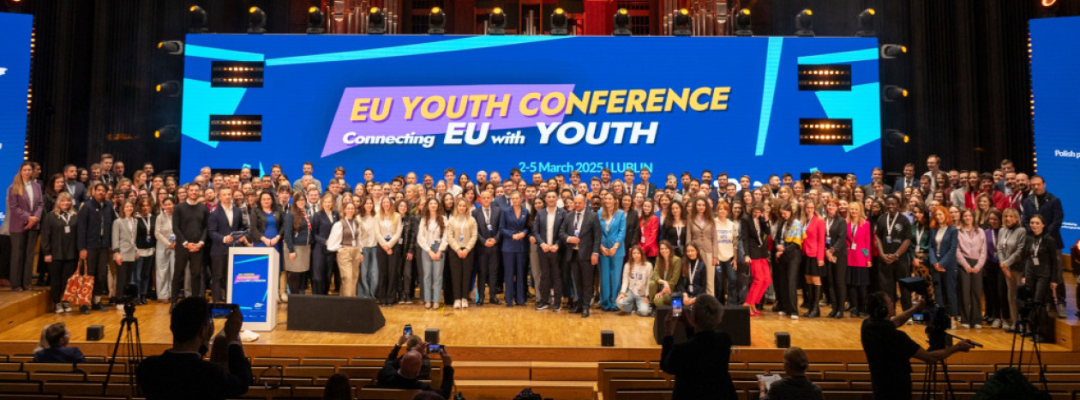
But how does it work? The EU Youth Dialogue is organised in 18-month work cycles, each focusing on a specific theme. Throughout each cycle, young people and policymakers take part in consultations, discussions and other dialogue activities at local, national and European level. Each cycle has two phases: the consultation phase, during which voices are collected, followed by an implementation phase, where ideas should be turned into action. The whole process is led by three consecutive EU Council Presidencies, each of which organises an EU Youth Conference (about every six months). In this way, youth’s ideas and concerns travel upwards through the different levels of governance, eventually feeding into discussions at the heart of Brussels.
The current 12th cycle of the EU Youth Dialogue (led by Ireland, Lithuania and Greece) started in July 2026 and is all about European Youth Goal #4: ‘Information and Constructive Dialogue’. During this cycle, young people will have the chance to share their ideas on access to information, artificial intelligence and disinformation campaigns. Another focus of the cycle is the revision of the European Youth Goals themselves, a set of 11 priorities for young people across Europe that guide European policy processes. This will come alongside the set up of the foundation of the next EU Youth Strategy.
Do you want to get involved? Participation in the EU Youth Dialogue usually takes place through youth organisations, particularly at national level. But do not worry, this does not mean that you need to be part of a large organisation to make your voice heard. A good place to start is to contact your national youth council (you can find the contact information here), which can provide you with all the information you need on the ongoing consultations and on the opportunities to get involved.
From Tools to Impact: Translating Youth’s Ideas into Policy
The EU Youth Dialogue is not just an amazing tool. It produces ideas that can be turned into reality. The conclusions that emerge from the different activities of the dialogue are presented to the Council of the EU, where they can feed into the political process and, ultimately, contribute to the adoption of policy documents reflecting young people’s views and priorities. The 2018 cycle is a good example of this, as it led to the creation of the 11 European Youth Goals. Following political discussions and negotiations with the Council, these goals were incorporated into the EU Youth Strategy, turning the ideas expressed by young people through the dialogue into a concrete reference point for youth policy in the EU.
Moreover, the dialogue, together with the EU Youth Strategy, has had an important role in promoting youth participation in the EU. The Flash Eurobarometer on Youth and Democracy 2022 shows this clearly: 37.8% of the young people interviewed felt that they had their voice heard on the future of Europe, to some or to a large extent. The numbers are not high, but they are definitely improving. These tools are also increasingly more inclusive in bringing the voices of young people from minority groups, young people with disabilities, and other underrepresented groups to the policy processes, which is essential to shape a future where everyone’s needs and ideas are taken into account.
But this is just the first step. Unsurprisingly, the process also has its flaws. Meaningful follow-up is essential to ensure that the ideas and recommendations emerging from consultations with and between young people in Europe do not simply remain on paper or become a box-ticking exercise, but have a real chance of feeding into policymaking. The current revision of the EU Youth Strategy is, in this sense, an important opportunity to strengthen the link between the Youth Dialogue and the policy process, while also ensuring that its outcomes are properly followed up, monitored, and translated into action. For change to happen, it needs to start with young people. Their voice has more power than they might think.
