

Elections in Sweden: What’s Next?

By Yza Schraal
On 13 September, the election period in Sweden came to an end. That day, Swedes voted in the national, regional and municipal elections all at the same time. With a far-right party no longer being excluded from a potential coalition and the social democrats making a comeback, it is safe to say that there was a lot at stake during the campaign period. The tensions were also visible in the election results. It remained unknown for a while what the results were. The left-wing block, led by the Social Democrats, won by a three-seat difference over the right-wing block. Now, the most difficult challenge begins: building a coalition.
Before diving into the elections, the Swedish party system requires an explanation. Swedish parties work in blocks, with a left-wing and a right-wing group of parties. These parties individually campaign in the elections, but do form a group together. This is supposed to make coalition building later on easier. It is common that a few parties form a coalition while the others in the bloc support this government. It is not uncommon for the government to be a minority coalition; thus, support from the bloc is needed to implement legislation.
The Election Campaign
The campaign period was intense, with three parties gaining the most headlines. The position of the leading party, Moderates, with (now former) prime minister Ulf Kristersson, was becoming uncertain due to declining popularity rates. This meant that the election could go either way. Their campaign was focused on what they had achieved during their time in office, namely strict migration policies and tackling gang criminality. Another strategy of the Moderates was to take a more extreme stance. Where their minority coalition used to rely on a 'shadow' support of the Sweden Democrats, they now decided to fully cooperate and embrace them in the right-wing bloc in the elections.
This, combined with the continuing rise of far-right parties all across Europe, meant that eyes were on Jimmy Åkesson’s Sweden Democrats. The origin of the Sweden Democrats starts with a group of neo-Nazi’s who do not remain uncontroversial. Their campaign themes were, similar to those of all other far-right parties in Europe, even stricter immigration policies and more focus on national culture. Unsurprisingly, their slogan this election was ‘Vi gör Sverige till Sverige igen’ (we are making Sweden, Sweden again), an uncreative take on ‘Make America Great Again’.
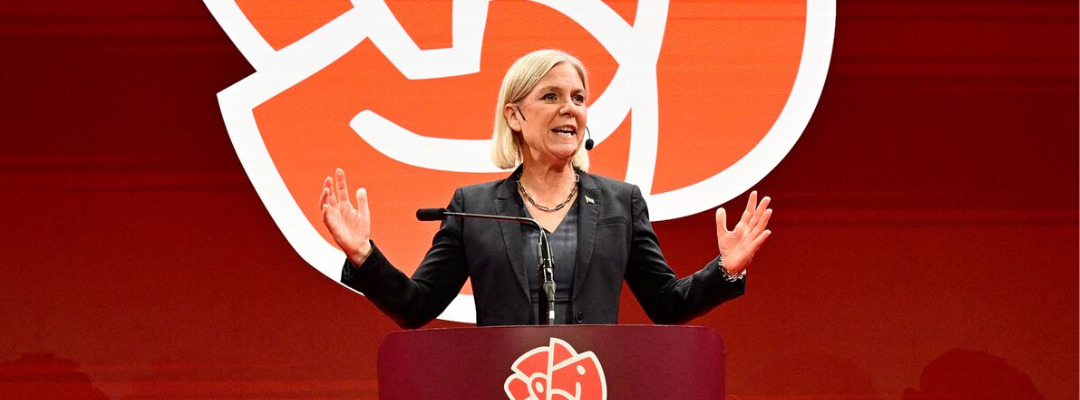
Similar in acronym, but definitely not in ideology, are the Swedish Social Democrats. The country is known for its social democratic political culture, but it experienced a period without the party being in the lead. However, they made a comeback this year, with former prime minister Magdalena Andersson as the party leader. Unlike the parties above, their main focus was not on immigration. Although they are in favour of stricter immigration policies, like their neighbouring colleagues in Denmark and Norway, the focus of the Social Democrats and other left-wing parties was on the declining quality of social services, such as education and healthcare.
Difficulty Coalition Forming
The existence of the two blocks should make coalition forming easier. However, this time it might be a bit more difficult. After the win of the Social Democrats, Ulf Kristersson stepped down, and the speaker of the Swedish Riksdag (Parliament) gave Magdalena Andersson the difficult task of creating a government. This time it is more difficult to negotiate because there is disagreement between the left-wing parties. The main issue is that the Centre Party does not want to be in a coalition with the Left Party, and the Left Party will only support this government if they are a part of it. The main disagreement, among other things, between the two is on taxes. If they are unable to come to an agreement, the right bloc led by the Sweden Democrats will then be given the chance to form a coalition. Being that this is the worst-case scenario for the left bloc, there is already some movement between the two left-wing parties. Negotiations should preferably be concluded before November in order to govern with a left-wing budget. If they need more time, they will have to lead the first period on the right-wing budget. So, the clock is ticking.
