

Poland and The USA: from Alliance to Geopolitical Tensions
By Jokin de Carlos-Sola
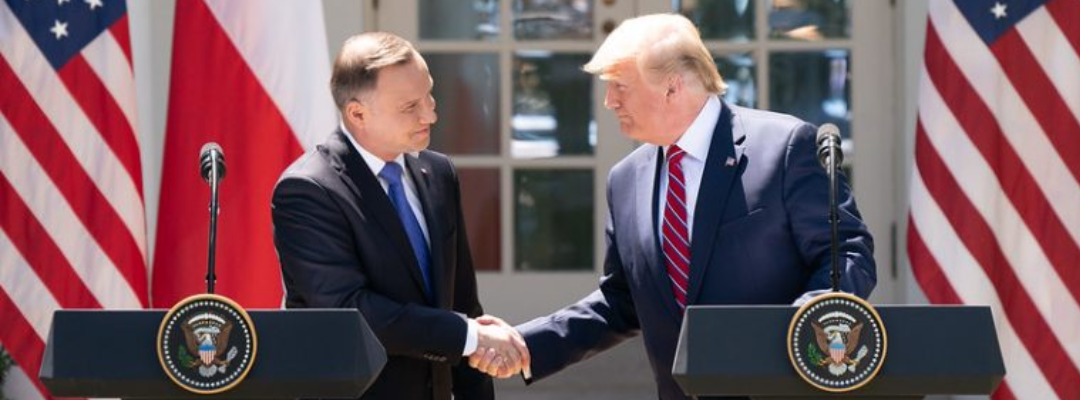
The relationship with the United States has been Poland’s main foreign policy priority ever since the end of Communism. This has been a matter of consensus across the entire Polish political establishment.
A good example of this is the 2003 support of the U.S.-led Iraq intervention, to which Poland contributed troops. It did so even though its Prime Minister, Leszek Miller, and its President, Aleksander Kwaśniewski, were both Social Democrats and former members of the Communist Party, the party that in the 70s and 80s led a diplomatic fight against American interventions. At a time when leaders in other European capitals were opposing the war, most notably France with Jacques Chirac and Germany with Gerhard Schroder, this shows the extent to which this alliance was seen as crucial.
Even though Poland remains strongly committed to transatlanticism and NATO, signs of friction between the Polish government and Washington, D. C., have emerged. The ongoing tension highlights growing concerns within parts of the Polish government regarding the reliability of American commitments under the Trump administration.
The slow friction between Poland and the US
One of the earliest sources of friction arose shortly after Trump took office in March 2025. At that time, Elon Musk was still a close ally of the President and presiding over the Department of Government Efficiency (DOGE). In a comment, Musk criticised Ukraine’s use and dependence on its Starlink satellite network. Polish Foreign Minister Radosław Sikorski pushed back, saying that Poland had been paying for Ukraine’s use of the satellite network. This, in turn, prompted more criticism from Musk, but most importantly, it brought in Secretary of State Marco Rubio, who sided with Musk against Sikorski. This can be seen as the moment when many Polish officials began viewing the alliance with the U.S. with more concern.
Ever since then, criticism of the Trump administration has become much more common in the Tusk government. Many have started to question America’s commitment to Europe. Tusk went as far as to say that while Poland was an ally of America, it was not a 'vassal'. This wording and tone of language is extremely rare in Poland and signals the mistrust that Polish officials have developed toward the American administration. Some observers have interpreted this rhetoric as an indication that Warsaw may seek greater room for manoeuvre within European security structures independently from the United States, though current policy remains firmly anchored in NATO.
Polarisation inside Poland in relation to foreign policy decisions
Opinions regarding the relationship to the US are also deeply divided along political lines. Polish society is currently experiencing growing polarisation. On the one hand, there is the governing centrist-progressive bloc, comprising Prime Minister Donald Tusk’s Civic Coalition and its allies in the centre and left. On the other hand, there is the Law and Justice Party (PiS), together with its two de facto far-right allies, Konfederacja and the Polish Crown. Both sides faced each other in the presidential elections, where Karol Nawrocki of PiS narrowly defeated Warsaw Mayor Rafał Trzaskowski by a fraction of a percent.
Nawrocki has taken the opposite line to Tusk, arguing that Poland’s alliance with the United States is of an existential nature, even more important than its EU membership. While both sides agree that America is a crucial ally for Poland, they disagree on how far this priority should go over European integration.
In 2027, Poland will have parliamentary elections. However, a victory for the right would not necessarily mean a clear return to an unquestioned pro-American foreign policy. Unlike in 2015, it is unlikely that Law and Justice will have a majority, and its current allies, Konfederacja and the Polish Crown, have elements that have expressed positions viewed as more accommodating toward Russia than those traditionally adopted by PiS.
The Ukrainian factor in Poland´s relations with the US
Ukraine is the most significant external variable shaping Poland–U.S. relations. It is the increasingly tense relationship between Kyiv and Washington that has prompted debate within Poland about the long-term reliability of American leadership in European security. Warsaw’s support for Kyiv remains a broad consensus in Poland, but it is also becoming a source of growing contention.
Tusk maintains his commitment to supporting Ukraine in its fight against Russia, despite the gradual American withdrawal. Meanwhile, Nawrocki has shown a more aggressive and critical stance toward Ukraine for a variety of reasons. These include Ukrainian grain exports, which have hurt Polish farmers, and the historical memory of the Second World War, where Poles were targeted by Ukrainian collaborators. Together with his allies in PiS, he seeks to prevent the Ukraine issue from shaping other aspects of Polish foreign policy. Their aim seems to be to manage the relationship in a more transactional way and avoid worsening relations with the United States.
Moving Forward
The key change in Polish–American relations is not strategic alignment, which remains intact, but the level at which disagreement now occurs. What used to be managed quietly within diplomatic channels is increasingly expressed publicly by senior Polish officials and occasionally escalates into direct exchanges with U.S. political or economic actors. This can have a long-term impact on the alliance, as harsher rhetoric and exchanges by American officials could easily create long-lasting diplomatic frictions.
While the alliance will remain and Poland will continue to strengthen its military capabilities alongside the U.S., other questions remain open. These include Poland’s role in a potential common European defence project, its relationship with Ukraine, and how it defines its future partnership with the United States.
