

Choose Your Defence on the Continent: Strongly Worded Letter or European Army?

By Iulia Beldean
On 19 May 2026, the Russian Foreign Intelligence Service (SVR) and UN Ambassador Vasily Nebenzya threatened retaliatory actions against Latvia’s government, accusing the country of giving Ukraine access to its airspace for launching drones, or even helping them do so from Latvian territory. In the following days, the Foreign Affairs Minister of Latvia dismissed the accusations, while the US Deputy Ambassador to the US mentioned, referring to the Russian claims, that there is ‘no place for threats against a council member’, drawing attention to NATO’s Article 5, meaning if Russia attacks Latvia, the entire alliance will be involved.
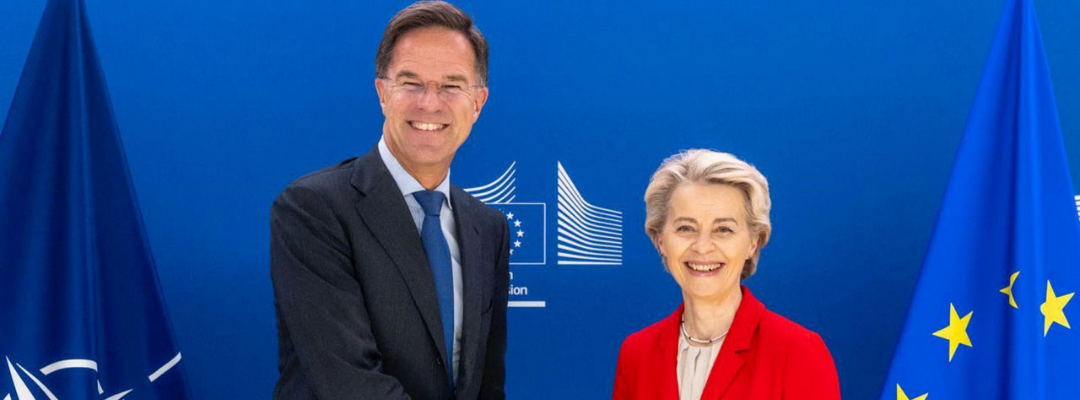
Only a day after the accusations, an air raid alert was issued in Vilnius, Lithuania, as a drone was spotted at the border, violating the country’s airspace, causing the President and the Prime Minister to take shelter in bunkers, as well as the rest of the capital’s population. The message that was sent by the country’s Defence Ministry read: ‘Air raid alert! Go immediately to a shelter or a safe place, take care of your family members and wait for further instructions.’ To make a statement, the EU Commission’s President, Ursula von der Leyen, wrote on social media: ‘Russia’s public threats against our Baltic states are completely unacceptable’. Only a week and a half later, on 29 May, a Russian drone hit a residential building in the town of Galați in Romania, at the Danube’s NATO border, injuring 2 civilians. Both the NATO Secretary General, Mark Rutte, and the Commission’s President made public statements condemning Russia, while Rutte had a private conversation with Romania’s President.
Russia has been testing the EU’s and NATO’s red lines for a while after the annexation of Crimea, but it is clear that the recent tests can be correlated with the more frequent attacks deep on Russian soil that are carried out by Ukraine’s army, like the attacks on Moscow’s oil refineries and residential infrastructure on 17 May this year, with analysts arguing that for the first time since the invasion, Ukraine has better ‘cards’ to play with. So Russia’s actions come from a place of desperation, but a country can grow more dangerous when it has nothing to lose.
NATO is already a coordinated alliance, with 32 different armies; the EU has 27, with different levels of preparedness and allocated budget; and while a bigger role is expected from European countries inside NATO, especially on conventional strategy (meaning using military capabilities that exclude Weapons of Mass Destruction), most of the military’s Chain of Command is American. Thus, the EU is already moving in the direction of building such resilience on its own, as seen in the defence omnibus released by the Commission in November 2025, which began with the Security Action for Europe (SAFE), launched in March 2025, to set the first pillar for the ReArm Europe plan, also known as Readiness 2030. It was developed alongside the White Paper on European Defence, authored by the European Commissioner for Defence and Space, Andrius Kubilius, and the HR/VP Kaja Kallas. ReArm Europe in itself is mobilising €800 billion for European defence spending by 2030. There are also ongoing discussions about the applicability of Article 42.7 of the Treaty of the European Union, which is the mutual defence clause.
SAFE (Security Action for Europe) proposes €150 billion in funding for EU Member States’ armies and imposes a minimum of 65% of the equipment to be of European origin, as the high-tech is currently of American origin. It was proposed by the Council of the EU in May 2025. So far, Poland has refused SAFE funding, alongside countries like Germany, Czechia, Hungary, and Slovakia. 19 countries so far have accepted it, and the rest have pending applications.
But how would a European Army actually come to fruition? While both the European Commission and the Council of the EU have shown initiative for European defence through these plans, the European Parliament proposed a European Defence Union Group that complements what the white paper lacks. The alliance is made up of 30 MEPs from different Pro-European political groups, like the EPP, S&D, Renew Europe, Greens/EFA. It was initiated as a response to Mark Rutte’s claims that if Europe thinks it can defend itself against Russia, it should ‘keep on dreaming’. The group proposes greater interoperability between armies, meaning greater cooperation and better synchronisation, because Member States delay their contribution, do not participate in the Commission’s programme and thus hinder any power of cooperation. At the same time, it imposes minimum standards for the national armies to improve the working conditions of their recruits, which can reduce the citizens' reluctance to join a national army.
While a European army as a concept is criticised for being far-fetched, its logistics are starting to take shape, out of necessity and pragmatism. Such plans include the European Drone Defence Initiative and the Eastern Flank Watch, meant to increase response capabilities at the Eastern Border; a European Air Shield for anti-missile defence, fully cooperative with NATO and its standards and doctrine, and a European Space Shield for better communication, navigation, and observation between Member States. There is also a European Defence Industry Programme proposal, ‘with an aim to boost the EU’s security and defence industry’, and bridge the gap of defence investment until the end of the 2021-2027 EU budget. As of now, EUMS, part of the EEAS, is the primary source of military knowledge in the EU.
The European Community was created as an alliance for peace and economic interdependence, to purposefully use the industry for economic growth and move away from national military ambitions, but in the same spirit, a project for a European Army can serve the same purpose, as it can put the EU in a better position diplomatically, especially in a world that is for now moving more into a direction of spheres of power.
