

Europe’s Competitiveness Myth: Why Europe Is Dismantling Its Own Strength
By Yann Sydow
‘It took 5 years to build the most comprehensive climate law framework in the world. It took just 12 months to dismantle it.’ - Alberto Alemanno
Over the past year, a new consensus has taken hold in Brussels. The claim is that the EU is a ‘regulatory burden’ for companies that hinders growth and innovation. Commission President Von der Leyen, underlines it clearly: ‘we need simplification, we need deregulation. We need it on the European level.’ At the same time, businesses demand ‘fewer rules’ to compete with the United States and China.
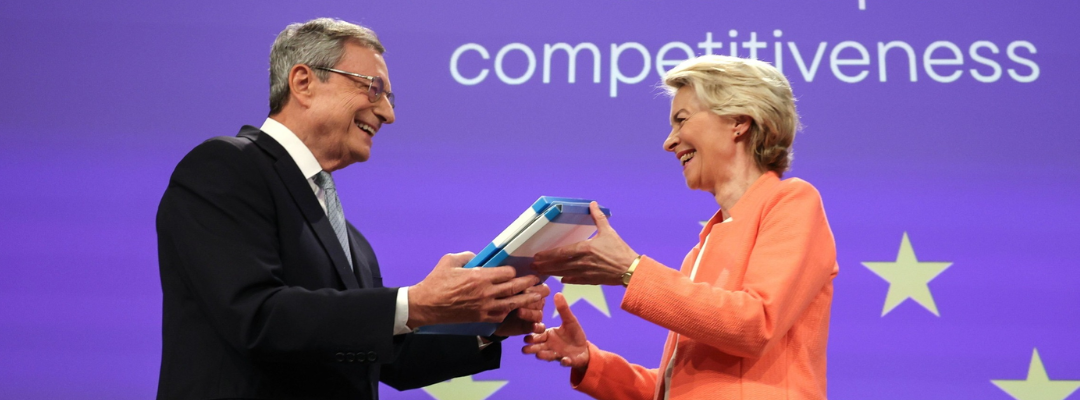
Few voices have shaped this narrative more than Mario Draghi. His widely discussed report on European competitiveness has given an attractive argument for what Eurosceptics have advocated for all along: that regulation is holding Europe back.
But there is a problem. This diagnosis is, at best, incomplete and at worst dangerously misleading. A myth that is destroying the European project from within.
The convenient story of ‘overregulation’
The idea that EU rules are strangling growth is politically appealing. It’s a populist argument, offering a simple solution to a complex problem: deregulate, simplify, accelerate. In practice, this has translated into ten new so-called ‘omnibus’ packages since 2025, legislative bundles that amend multiple laws at once, often at speed with limited scrutiny.
At first glance, this sounds reasonable. Who would oppose simplification? Isn’t that one of the purposes of the EU – harmonising a Single Market composed of 27 member states?
Yet this is where a deeper contradiction emerges.
The paradox
On the one hand, Ursula von der Leyen insists that Europe must remain a predictable and reliable actor, committed to ‘defend(ing) and uphold(ing) the rules-based system’ to maintain its global influence. On the other hand, the Union is increasingly willing to do the exact opposite: diluting, delaying and reopening its own rules in the name of competitiveness. This isn’t just inconsistent - it could end up hurting Europe strategically.
For decades, the EU’s strength has rested on two pillars: the scale of its Single Market and its ability to translate that scale into regulatory power. Access to a market of 450 million consumers has allowed the EU not only to set rules internally, but to project them externally. The result is companies and even third countries complying with EU standards outside of its own market.
A notable example is the General Data Protection Regulation (GDPR), which forced tech companies such as META, Google and Apple to apply privacy rules worldwide. Firms prefer one global privacy standard rather than region-changing systems, and because access to the EU market is indispensable, that standard is often European. From developing a unified USB-C charger to innovative environmental regulation, EU rules have often become global benchmarks, a phenomenon commonly referred to as the ‘Brussels Effect’.
In that sense, regulation is not a burden: it is power.
The hidden costs of deregulation
Besides losing geopolitical weight through its regulatory power, deregulation also does not, as Von der Leyen puts it, 'make business in Europe easier'. It is not European SMEs that are profiting from 'simplification' but rather large multinational corporations, many of which are non-European.
US tech giants fined by the EU for not respecting competition and data protection rules have long argued that European regulation stifles innovation. This is because EU rules limit their market dominance and business models. The United States eurosceptic rhetoric only confirms this, with Trump stating that 'the EU was formed to screw the US'. Worryingly, a recent study of parliamentary activity in late 2025 found that American lobbyists were present ‘95% of the time Parliament was in session.’
China is the EU’s main adversary in regulation (especially in the climate realm), and deregulation would mean less regulatory competition in setting global standards. This matters because, as the Centre for European Policy Studies puts it, ‘whoever sets the rules and standards for new technologies usually goes on to dominate those markets.’
Fossil fuel companies that want to continue profiting at the expense of the well-being of the planet feel threatened by key EU legislation such as the Green Deal and carbon-pricing mechanisms. For example, a recent NGO report found that fossil fuel lobbies ‘were present in Parliament on 87.5% of sitting days’, slashing key sustainability laws to protect their high-emission business models.
In addition, the argument that this 'simplification agenda' would reduce administrative burden and costs is also false. The estimated economic gain of deregulation, according to the European Commission, stands at around 0.07% of the EU’s GDP.
Furthermore, bundling complex revisions into dense and technical legal packages creates rules that are harder, not easier, to understand. Companies may face fewer formal requirements, but they increasingly need legal experts just to interpret what remains. Therefore, the regulatory burden does not disappear but is rather distributed. As a scholar put it: 'That’s not simplification. That’s cost-shifting.'
This deregulation also means that EU standards that protect citizens, workers and the environment are at peril. Multiple European Citizen Initiatives have gone unnoticed, with corporate lobbyists taking over the EU’s political direction. The Pay Transparency Directive, aiming at closing the gender pay gap, has been intentionally delayed, and BusinessEurope (the largest EU business lobby group) 'wants to scrap the obligation to record working hours’, doing so quietly under the omnibus packages.
More worryingly, the speed at which these omnibus packages are passed raises serious concerns about democratic oversight. Impact assessments are shortened or bypassed, for example, in 2024, 85% of all Commission proposals 'were not subject to a full impact assessment and public consultation'. Notably, more than 60% of visits by fossil fuel lobbyists were not tied to any declared meetings. Even the European Ombudsman has flagged maladministration in how some of these packages were prepared.
This has led some observers to speak of a 'democratic winter' in Europe: not a collapse of democracy per se but a decrease in transparency, accountability and debate. Under the label of 'competitiveness' and geopolitical urgency, decision-making is becoming more centralised and less transparent, with limited involvement of civil society. Concerns have been raised, for instance, over the growing reliance on informal, closed-door summits such as the February 12 meeting at Alden Biesen Castle, where discussions around expanding omnibus packages take place with minimal scrutiny. This has the potential of reshaping legislation without meaningful public oversight.
There is a clear tension here. Just as the EU is trying to strengthen its global position, it risks weakening one of the things that made it strong in the first place: its credibility as a rules-based democracy.
What really holds Europe back
Draghi’s analysis was clear. Europe’s competitiveness gap is not primarily driven by regulation but by structural weaknesses such as chronic underinvestment, fragmented capital markets, high energy costs and overall strategic dependencies. Although a Single Market exists on paper, it remains deeply fragmented and incomplete, which hinders innovation. For instance, the International Monetary Fund estimates that internal barriers to the Single Market are, on average, equivalent to a tariff of 44% for goods and a staggering 110% for services.
Additionally, if the EU truly wants to be competitive, it needs to prioritise diversification. Competitiveness is not only about reducing regulatory burden, but also about strategic autonomy and resilience.
The EU’s post-2022 energy shift illustrates this: reducing dependence on Russian gas has often meant replacing it with costly LNG imports, notably from the United States and the Middle East, as such creating new vulnerabilities rather than eliminating them. This is now costing the EU an average of €500m per day due to the Iran war.
If this is meant to be Europe’s 'moment of independence', as von der Leyen put it, deregulation is taking the EU in the opposite direction. A Europe that competes by lowering standards and bypassing democratic safeguards does not become more competitive – it becomes weaker.
