

The Slow Death of the European Green Deal?

By Yann Sydow
The EU, a global climate leader?
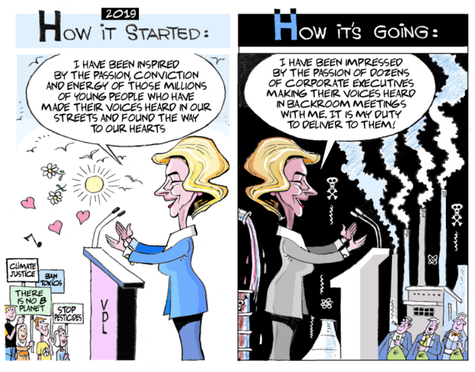
In 2019, shortly after being elected as the new President of the European Commission, Ursula von der Leyen introduced the European Green Deal as the defining political project of her mandate. At the height of the Fridays for Future protests and growing public awareness over climate change, she described the Green Deal as ‘Europe’s man on the moon moment’,
which ‘we owe to our children because we do not own this planet’. According to Von der Leyen, this would be the EU’s ‘new growth strategy’ to become ‘the frontrunners in climate-friendly industries’, fundamentally reshaping and transforming the European economy and society.
At the time, its ambition seemed unprecedented. The EU presented itself not merely as another climate actor, but as the global leader in climate governance, building on a role it had cultivated since the 1990s through initiatives such as the Kyoto Protocol and later the Paris Agreement. While responsible for roughly 6% of global greenhouse gas emissions today, the EU has already managed to reduce its emissions by 37% since its peak in the 90s, while simultaneously growing its GDP by 71%, proving that economic growth and decarbonisation can go hand in hand (although critics note that part of this decoupling also reflects deindustrialisation, outsourcing and carbon leakage).
Against this backdrop, the Green Deal became far more than just another climate policy package. Its aim is for Europe ‘to be the first climate-neutral continent’ by 2050, a target later made legally binding by the EU Climate Law in 2021. Further proof of this ambition is how the EU raised its 2030 emissions reduction target from 40% to at least 55% compared to 1990 levels.
What made the Green Deal particularly significant was its scale. It is not, as the name misleadingly suggests, a ‘deal’ or a single environmental regulation, but an attempt to reorganise Europe’s entire economic model around decarbonisation. It affects all policy sectors from energy, transport, agriculture and biodiversity to trade, industry, and finance. Key policies such as the expansion of the EU Emissions Trading System (ETS), the Carbon Border Adjustment Mechanism (CBAM), stricter car emissions rules, biodiversity legislation and the Social Climate Fund all emerged under the broader ‘Fit for 55’ package.
The Green Deal also had a geopolitical dimension. Since Russia’s full-scale invasion of Ukraine in 2022 and the resulting energy crisis, reducing dependence on imported fossil fuels has become even more of a strategic priority. Through the REPowerEU plan, Brussels linked climate policy directly to energy security and strategic autonomy. The Green Deal, therefore, was not only framed as a way to reach climate neutrality but also to strengthen strategic autonomy through, for instance, expanding renewables and self-reliance.
Green Backlash
Today, this momentum seems to be stalling.
European leaders are increasingly framing the Green Deal as the source of the EU’s economic stagnation and fear losing competitiveness. Italian Prime Minister Giorgia Meloni suggested that ‘in a desert there is nothing green’, suggesting that economic decline would ultimately undermine environmental ambitions. Meanwhile, German Chancellor Friedrich Merz criticised the EU’s growing regulatory framework and the ‘Brussels machine,’ arguing that ‘we need to throw a spanner in the works of this machine in Brussels now, so that it stops.’
The language coming out of Brussels also began to shift. Terms such as ‘climate leadership’, ‘transformation’ and ‘green transition’ were increasingly replaced by concepts like ‘competitiveness’, ‘simplification’ and ‘overregulation’. For instance, in early 2025, the European Commission published its new ‘Competitiveness Compass’, a major strategic document focused on industrial competitiveness and economic security. Notably, the term ‘Green Deal’ was non-existent, which is ironic, given that Von der Leyen stated in 2019 that the Green Deal was supposed to be the EU’s ‘new growth strategy’. This change in political framing matters because it increasingly translates into concrete policy changes.
The rollback of Green Deal legislation has generally taken three forms: delays, weakening and, in some cases, complete withdrawal of the regulation. The table below illustrates a few of these pieces of legislation.
Why is this happening?
There are several forces driving this shift.
First, there are the farmer protests, which became one of the most visible symbols of resistance against Green Deal policies, especially in late 2023 and early 2024, which led to tractor blockades and demonstrations in many EU capitals. For many, the imposed environmental regulations were seen as additional administrative burdens at a time when farmers were already struggling economically.
This came at a very sensitive time, just before the European Parliament elections in June 2024, which saw an increase in right-wing and Eurosceptic parties across several member states, while centre-left parties lost a considerable number of seats. This has increasingly allowed the biggest European party, namely the European People’s Party (EPP), to cooperate with more climate-sceptic forces on certain files, weakening the broad pro-Green Deal coalition that existed during the previous mandate. Ironically, while calling for ‘simplification’ and 'competitiveness’, it is precisely the EPP that put these same Green policies into place.
Then, in September of the same year, the Draghi Report on European competitiveness further reinforced concerns that Europe risks falling behind economically. While the report did not reject climate action itself, it misleadingly strengthened the myth that regulation and administrative burdens were undermining Europe’s economic performance.
Just a few months later, Donald Trump returned to the White House in 2025. The openly climate-sceptic president, who has vowed to continue extracting fossil fuels as long as possible, campaigning with slogans such as ‘drill, baby, drill’, only accelerated global pressures for dismantling Green Deal policies. Earlier this year, US Ambassador to the EU Andrew Puzder argued that Europe ‘needs more fossil fuels – full stop’, claiming that ‘a modern economy cannot rely on weather energy to thrive’ and that the ‘US can provide that needed energy’. Besides the blatant greenwashing, such a statement reflects the broader American interest in weakening climate regulation, which is impeding many multinational American companies from gaining profit at the expense of the planet.
In addition, industrial actors, particularly parts of the automotive and manufacturing sectors, are increasingly warning of declining competitiveness. Faced with rising Chinese green technologies, many companies began lobbying for weaker environmental obligations and regulatory simplification. As the Director General of ACEA, Europe’s largest automotive lobby group, argued, ‘a major challenge for the automotive sector over the last years has been the sheer volume of new legislation,’ with some climate regulations allegedly failing to achieve ‘the environmental benefits [they] claim[] to deliver.’ Political allies such as Manfred Weber, EPP president, agree, stating that ‘We can only win the fight against climate change if we combine it with an economically reasonable approach‘.
The irony here is that the Green Deal was designed to protect the Single Market and strengthen European industry; therefore, weakening it may ultimately undermine Europe’s own competitiveness. Moreover, many of the companies now warning about Europe’s technological gap with China were themselves slow to invest in green innovation and spent years resisting or delaying parts of the green transition that could have strengthened Europe’s position in emerging industries.
In many ways, this change in tone is a result of a ‘polycrisis’ or, as some suggest, ‘permacrisis’ with inflation, high energy prices, industrial fears of deindustrialisation, geopolitical instability and growing social discontent.
So is the Green Deal dying?
Declaring the death of the European Green Deal would be premature. While the current political momentum is severely diluting many of the key Green policies, there is still hopeful news. Under the EU Climate Law, the net-zero target of 2050 and the reduction of GHGs by at least 55% by 2030 remain legally binding, so EU institutions and Member States are obliged to adopt policies with these goals. The ETS continues to expand, CBAM is moving forward, and renewable energy investment continues to grow across Europe, while energy crises continue to strengthen the case for reducing fossil fuel dependence from autocratic states.
As of early 2025, the European Commission had proposed around 168 initiatives under the Green Deal framework, of which 98 had already been adopted by the Parliament and Council, while 37 remained under negotiation and a further 28 had been announced. The EU’s Emissions Trading System (ETS), launched in 2005 as the world’s first major carbon market, remains the largest globally and has inspired similar mechanisms worldwide. By 2024, 36 ETS systems were in force globally, with many more under development, covering jurisdictions representing roughly 58% of global GDP. At the same time, renewable energy sources accounted for more than 47% of EU electricity generation in 2026 and, in many contexts, have become increasingly cost-competitive with fossil fuels.
These developments are by no means meant to undermine the disastrous green backlash that is happening today. Fossil fuels still account for 67.4% of the EU’s energy mix, while the global figure remains a staggering 82%, most of which comes from emerging and developing countries.
Concluding Remarks
In 2025, Ursula von der Leyen declared that ‘this must be Europe’s independence moment,’ referring to an increasingly hostile global order in which interdependence is increasingly weaponised. Against that backdrop, weakening one of the EU’s most ambitious and strategic policy frameworks seems deeply contradictory. The Green Deal was not only about climate policy; it was also meant to reduce dependencies, strengthen Europe’s industrial base and prepare the EU for a more competitive and unstable world. The contrast with the optimistic ‘man on the moon moment’ rhetoric surrounding the Green Deal’s launch in 2019 is therefore striking. What was once presented as Europe’s ‘new growth strategy’ is now increasingly framed as a burden on competitiveness. In many ways, this reflects short-term political calculations at a time when climate change continues to accelerate, and global emissions keep rising.
