

Short History of Pride in Europe, From Protest to Public March for Human Rights
By Iulia Beldean
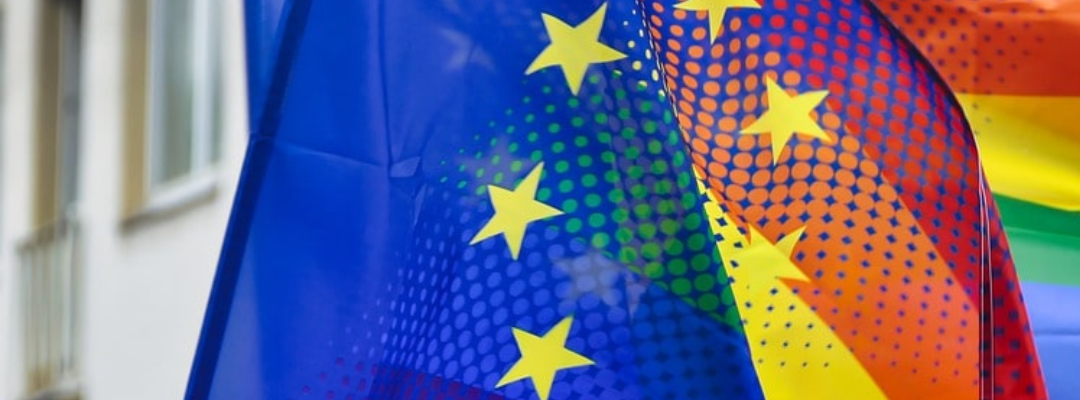
In this day and age, Pride in Europe means embracing love and diversity. It’s an opportunity for the EU to promote itself on the international stage as a safe space for different identities. Its importance goes beyond a public protest; it attests to the right of members of the LGBTQIA+ to express their love and gestures of affection out in the open, not only in protected spaces like gay bars.
Held from May to July, this period brings together events with multiple local flavours from different European countries, all uniting in the same principle of the primacy of human rights. Depending on the location, some feel like a party, where gay marriage has been legal for more than twenty years, like the Netherlands since 2001, Belgium since 2003, and Spain since 2005, while in the Eastern Bloc, they still feel like a protest for recognition of civil partnerships or any other form of protection of queer families.
Regardless of their imperfections, being occasionally used for corporate pinkwashing and feeling as if they diverge from their original purpose of a protest, they remain one of the most powerful weapons for the expression of the queer community. The first Pride event that took place in Europe wasn’t on the mainland;it happened in London on 1 July 1972, marking the third anniversary of the Stonewall riots in the US. Those protests are to this day considered to bethe turning point in queer visibility globally. Branches of the Gay Liberation Front formed in the UK at that moment, and some of the activists also travelled to the US to attend the Black Panthers’ Revolutionary People’s Convention and took inspiration from their type of protest. Even earlier, in 1970, a liberal activist was arrested for protesting in Highbury Fields, on the basis that he was exhibiting what was then called 'importuning,' meaning searching for a sexual partner in public.
Back in Europe, Madrid held its first Pride event in 1978, just 3 years after the dictator Francisco Franco’s death. Belgium held another Pride celebration inGhent in the same year. This was then followed by Berlin in 1979, as well as a law in Sweden removing homosexuality from the list of mental disorders due to the occupation of the National Board of Health and Welfare by a group of activists. Even if organised by local feminist or gay associations, these marches gathered people in their tens of thousands, the London Pride alone gathering 30.000 people.
In the 1990s, the movement was already heavily established, as the legislation on LGBTQIA+ was easing up or as some legal protections were being put in place. In Eastern Europe, the first Pride event was held in Budapest in 1997, followed by Minsk in Belarus in 1999, and then Zagreb in Croatia in 2002, Bucharest in Romania in 2005, the Baltic States in 2009 and Warsaw in Poland in 2010.
On the other hand, Pride is never short of homophobia or attacks from extremist groups, police violence, or governmental repression, and they are still part of our community’s daily reality. One important example is theBelgrade Pride, which organisers tried to put in motion repeatedly but had to cancel multiple times, citing public safety concerns from the threat of far-right extremist groups who would frequently try to pass by the police to assault the participants. In 2010, during one of those attempts organised as part of an attempt to promote the country for the EU accession as a place with respect for human rights, the celebration ended up marred by violence from far-right groups, and a significant presence of the police was required for just 1000 participants. During Brussels Pride in 2026, 3 performers were attacked on the street, just 7 minutes away from the main Pride stage, by a group of teenagers. They have previously posted on social media about the situation, raising awareness about the looming hate crimes that are still prevalent.
