

The Fish Rots from the Head: How a Leader we all Grew Up with Might Soon Fall
By Iulia Beldean
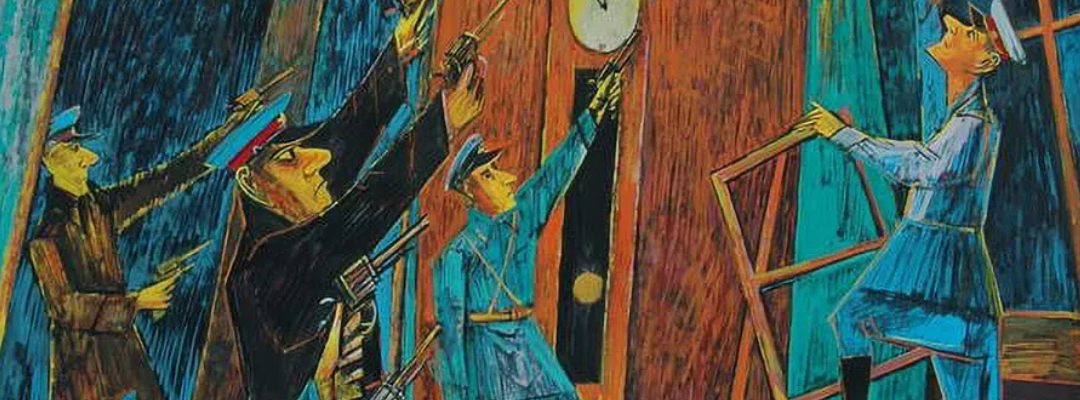
‘But what happened in Moscow after sunset on that Saturday evening when Woland and his followers left the capital and vanished from Vorobiovî Hills? There is no need to mention the flood of incredible rumours which buzzed round Moscow for long afterwards and even spread to the dimmest and most distant reaches of the provinces. The rumours are, in any case, too nauseating to repeat.’
These are the first words from the epilogue of Mikhail Bulgakov's book, Master and Margarita, describing the inter-war high society of Soviet Moscow. Woland, who represents the Devil, is the reader’s window into the corrupt and vile elite Soviet society, and travels with a band of diverse characters, including an assassin and a talking black cat. The book was banned during Stalin’s regime for years on end, being published posthumously and censored in Moscow in 1967, and as a complete, unmodified book in Paris in the same year. The quote selected can easily bring us to a more recent time, when Putin’s decades-long rule might come to an end. His political and military decisions, suicidal in character, are actually a reaction to a failed invasion that starts to show cracks and make his loyalists lose interest or patience.
Russian elections, recent NATO alerts and Zelensky barely escaping a possible assassination
The elections for the Duma, meaning the legislative Russian institutional bodies, held in the weekend of 18-20 September had a result that was widely anticipated, where the ruling party kept the constitutional majority, winning 349 seats. The rest was split between the Communist Party of the Russian Federation with 37 seats, the Liberal Democratic Party of Russia with 23 seats, New People with 19 seats, A Just Russia with 17 seats, and Rodina with one seat. The four remaining seats were distributed to self-nominated candidates. The polling turnout was more than 59%, even if the elections were under heavy surveillance and used fake observers, as the European Platform for Democratic Elections proved using open-source intelligence. So, if the results show a clear regime continuation, what is the source of Putin’s growing anxieties?
Yulia Galyamina, an opposition politician who still lives in Russia, mentions in an interview for the independent newspaper Bereg that even devoted supporters of Putin are starting to lose interest and are becoming anti-war. There is also a growing party, labeling itself as liberal, which is trying to capitalise on the growing anti-war sentiment: its leader, Yabloko, who was also barred from running in these elections, would have gathered 18% of the votes. This gradual societal shift, closely monitored by the Kremlin, combined with the recent Ukrainian attacks on its infrastructure and deposits, puts pressure on Putin, which led to recent NATO warnings about an attack in the territory belonging to one of the allies, and a possible assassination attempt on President Zelensky earlier this month, when he was planning a visit to Oslo. The Russian leader may grow more impatient, knowing his reign may be coming to an end.
Putin—Invisible clerk turned tyrant
During the fall of the Berlin Wall, a 37-year-old KGB agent with the rank of lieutenant colonel, Vladimir Putin, was stationed in Dresden when a crowd of protesters storming the Stasi headquarters also tried to break into the KGB local office. Putin tried to warn the protesters not to attempt to come in, threatening them that the agents were armed, although he knew that he couldn’t shoot. Later, he called a local Red Army tank unit, only to receive the devastating news that there was nothing they could do without orders from Moscow, and Moscow stayed silent.
This is later said to be the origin of Putin’s political mentality, as later in 2007, at the Munich Security Conference held in February 2007, he recalls the fall of the USSR as the ‘greatest tragedy of the 20th century.’
His upbringing was particularly modest: growing up in Saint Petersburg, the siege of Leningrad killed his brother, his parents barely survived, and he lived in a communal house, fighting off rats and cockroaches. At 16 years old, he was recruited by the KGB. In 1990, he resigned from the secret service, becoming an advisor to the head of the Saint Petersburg city council, Anatoly Sobchak, advancing to deputy mayor in 1994, and relocating to Moscow in 1996, to manage state property administration, as he gained a good reputation in Sobchak’s office. In 1997, he became the deputy chief of the presidential staff during Yeltsin’s presidency. In 1999, after Yeltsin resigned to not create a power vacuum, he appointed Vladimir Putin with full confidence. While his predecessor promoted massive privatisation, Putin imposed a more state-controlled economy, crashing most of the oligarchy. In the following years, he would embark on a massive assassination campaign against investigative journalists and surround himself with loyalists.
Conclusion
So, in the end, will Putin leave Moscow, like Woland did, leaving the Russian citizens to understand for themselves why that happened? Will he face the ICC, or will he manage to keep his power in check? Regardless, the rumours have new ways to be spread, and they will be heard across the entire European continent.
