

Let the Milano-Cortina 2026 Winter Olympic Games Begin, and May the Odds Be Ever in Your Favour
Inside the Political Forces Shaping Italy’s Most Anticipated Sporting Event
By Gloria Aleotti
Are sports events political? Well, if you still believe they are neutral, a closer look at Milano-Cortina 2026 might change your mind. Between geopolitical tensions, institutional controversies, economic disputes, protests and symbolic bans that have divided athletes and governments alike, Milano-Cortina 2026 is shaping up to be one of the most politically charged Olympics in recent memory.
New Development or Recurring Pattern?
This is not the first time. The Olympic Games have long collided with geopolitics, from Russia’s suspension following its invasion of Ukraine to South Africa’s three-decade exclusion over apartheid. More recently, Beijing’s moment on the global stage was overshadowed by a US-led diplomatic boycott protesting China’s treatment of the Uyghur minority. According to Madrid’s Instituto de Empresa Assistant Professor Andrew Bertoli, who studies the intersection of sport and politics, ‘An event like the Olympics is inherently political because it is effectively a competition between nations.’
However, this year’s Olympics have assumed a distinctly political edge, as Trump’s policies cast uncertainty over established US-Europe partnerships. In fact, the US President did not attend the opening ceremony at Milan’s San Siro Stadium. Yet, the organisation reserved a seat for his designated representative, Vice President JD Vance, who did not receive the warmest of welcomes, a clear reminder that diplomatic strain can spill well beyond official channels.
When Protests Hit Home
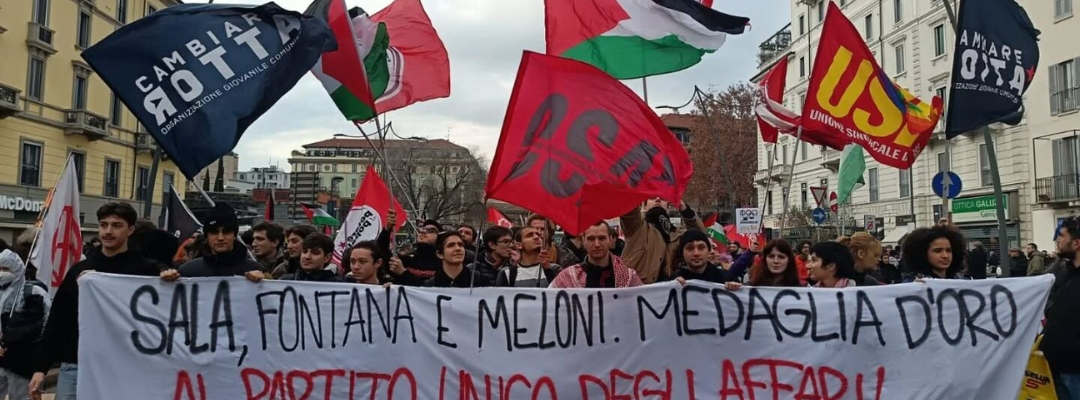
Beyond the competition venues, Milan itself became a parallel stage on the eve of the Games, and not only for high-level political meetings, but also for visible public dissent. On Friday, 6 February, activists and students gathered to protest the presence of ICE, the controversial US immigration enforcement agency, which has featured in recent headlines and is widely criticised for aggressive raids and unlawful detention practices resulting in civic unrest. Among the banners displayed, some read ‘ICE out’, while others criticised Giorgia Meloni’s government as well as Milan’s mayor, Beppe Sala. The following day, grassroots unions took to the streets over sustainability concerns andthe environmental cost of hosting an event like the Winter Olympics. Italy’s railway infrastructure was also deliberately damaged, a development that Meloni seized on to brand protesters as ‘enemies of Italy’ on social media. Italian Transport Minister Matteo Salvini was also quick to link the episodes to the Milano-Cortina Winter Olympics, saying in a statement on Saturday, 7 February, that ‘The serious acts of sabotage […] are worrying and echo the acts of terrorism that occurred in France just hours before the opening of the Olympic Games in Paris’, a reference to the arson attack that hit the French railway infrastructure in July 2024. What is clear is that, from official statements to social media declarations, this year’s Games have been transformed into a tool for political performance, where national image and party agendas take the centre stage.
What About Ukraine?
Ukrainian skeleton racer Vladyslav Heraskevych was disqualified before his first run, after the International Olympic Committee (IOC) banned his custom-made helmet. Yet, the helmet, which featured portraits of Ukrainian athletes killed since Russia’s full-scale invasion in 2022, contained no slogans or political symbols. Ukrainian Foreign Minister Andrii Sybiha slammed the IOC’s decision, saying that the athlete ‘simply wanted to commemorate fellow athletes killed in war’, adding that ‘there is nothing wrong with that under any rules or ethics’.
According to the Court of Arbitration for Sport, while the guidelines state that ‘freedom of speech is a fundamental right of any athlete competing in the Olympic Games’, they also ‘limit the right to express views during competitions on the field of play.’ In response, Heraskevych pointed on his social media platforms to several similar instances at the 2026 Olympics in which athletes honoured the memory of the deceased without facing punishment. One illustrative case is Israeli skeleton racer Jared Firestone, who, during the opening ceremony of the Games, honoured the memory of those lost at the 1972 Munich Games by wearing a kippah inscribed with the names of the athletes and coaches who were killed. While the rules promise freedom of expression, their application seems to suggest that context (and, perhaps, politics) still dictates what is permitted on the Olympic stage.
Olympics and Politics: Friends or Enemies?
The Olympic Games are meant to symbolise unity and moments of truce. Even so, pretending they exist ‘above politics’ hands them to those eager to wield them for their own gain and political agendas. In reality, sports events and politics are intertwined and denying this reality risks transforming the Olympics into a stage for ambition rather than ideals of unity and peace. History has shown it before. Without learning from Milano-Cortina, the cycle will repeat.
