

Spain’s Abortion Reform in a Fragmented Europe

By Beatriz Santos Mayo
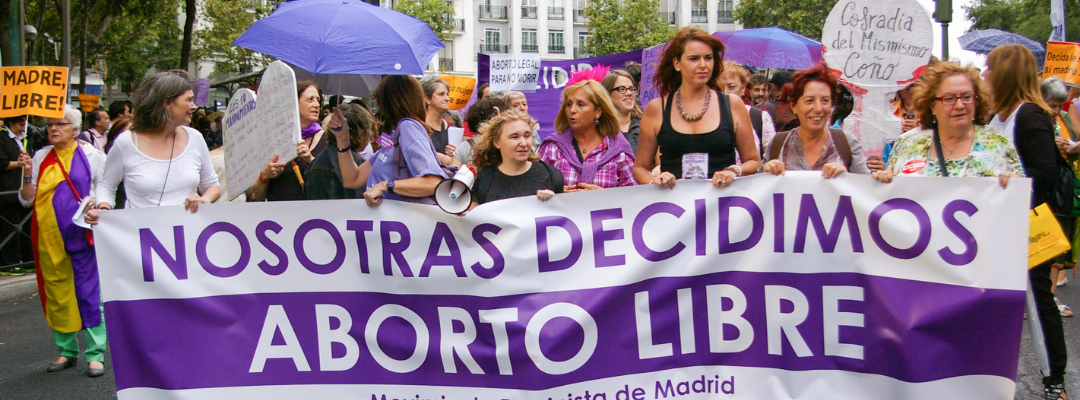
The Spanish government wants abortion to be a constitutional right. This comes at a time when Europe is already trying to protect reproductive rights in law. The proposal unfolds within a domestic context shaped by uneven access to public healthcare due to the regional-level administration of health services. So, what stage has the Spanish process reached, and why is the debate more complicated than it first appears?
Spanish Constitutional Bumpy Road
On 3 October 2025, the government announced a reform proposal to include the right to abortion in the Constitution to 'ensure the freedom of women', as the Spanish government argues. The proposal reached the Congress plenary in April 2026, where it survived initial attempts to block its processing. The proposed whole amendments tabled by PP (EPP) and Vox (Patriots of Europe), failed to secure a majority. These amendments tried to frame the reform as constitutionally improper. The PP and Vox described the initiative as a use of constitutional reform for political advantage. They argued that the government should have used Article 15 of the Constitution if it intended to elevate abortion protections, which would trigger the aggravated amendment procedure under Article 168, including dissolution of the Cortes (Congress and Senate) and new elections.
But that didn’t happen, and now, the law text will continue its parliamentary path, requiring a three-fifths majority in both chambers, the Congress and the Senate. However, the timings are outside the planetary activity. The Congress is in recess following a planned break after the start of the month and the additional pause designed to avoid influence on the Andalusian elections, which took place on 17 May.
A European Movement?
The Spanish proposal comes only a year after France constitutionalised abortion on 8 March 2024. French lawmakers approved an amendment recognising abortion as a 'guaranteed freedom' in a 780 to 72 vote.
However, across the European Union, the picture is uneven. Eurostat data shows abortion rates vary widely, from around 18.6 per 1,000 women in Estonia to 0.1 in Poland (2014 data). The European Commission has also noted that around 483,000 unsafe abortions occur in Europe each year.
By the Law
At the European Union Level, the treaties do not explicitly recognise a 'right to abortion' or a comprehensive catalogue of sexual and reproductive health rights (SRHR). Instead, protection is derived through a combination of fundamental rights and sector-specific competences.
Under the Treaties, the EU is said to be based on respect for human dignity, equality, and human rights (Article 2 TEU), which underpin all Union action. In addition, Article 8 TFEU requires the Union to aim to eliminate inequalities, providing a horizontal obligation that can be linked to reproductive health and access to healthcare services. However, health policy itself remains primarily a supporting competence under Article 168 TFEU. This means that the EU can complement national policies, support cooperation, and set minimum standards in certain areas, including abortion services.
Moreover, the European Convention on Human Rights (ECHR) does not contain any provisions in terms of abortion. Instead, most of the discussions about it are placed under Article 8. This article protects the right to private and family life and permits the state to interfere only when it is lawful, necessary, and proportionate. Additionally, Article 35 ensures the right to access preventive healthcare and to benefit from medical treatment under conditions established by national laws and practices.
Recognition and Legal Silence
Spain’s idea to put abortion in its Constitution is happening in a Europe where things are still not very clear, and it is under each country's discretion. For example, 'My Voice, My Choice' citizens' initiative, despite gathering a million signatures, did not lead to a new EU-wide right or common rule on abortion. The European Commission instead said that abortion policy stays under national control, and that the EU can only support Member States through existing tools like the European Social Fund Plus, if they choose to use it.
What this really shows is a gap. There is support, there are votes, there are declarations, but when it comes to binding law, things move slowly, and abortion stays inside national control. The EU can talk about equality and healthcare, but it cannot fully decide how abortion should work across all Member States. And for now, that tension between national reform and European limits is not going away.
