

A Bridge Between Two Europes: Frankfurt (Oder) / Słubice

By Marianne Bruneton
Before 1945, Frankfurt (Oder) and Słubice were one single city, both banks of the Oder sharing one administration, one economy, one community. On April 19, 1945, retreating German soldiers blew up the bridge to slow the advancing Red Army, cutting all connections overnight. The Potsdam Agreement then drew the Oder-Neisse line as the new German-Polish border, splitting the city in two. The eastern suburb, Dammvorstadt, was renamed Słubice and transferred to Poland. Its 8,000 German residents were expelled westward, replaced by Polish settlers who were themselves refugees displaced from eastern territories absorbed by the Soviet Union.
Two traumatised communities now faced each other across a river with no shared history, no common language, and deep mutual suspicion. Under the GDR (German Democratic Republic), the bridge was rebuilt in 1952 but reserved for party delegations, not citizens. A brief opening in 1972 allowed visa-free travel before the GDR shut the border again in 1980, fearing the influence of Poland's Solidarność movement. It took the fall of the Iron Curtain in 1989 to finally reopen the bridge, and this time, for good.
Europe steps in: from ruins to a laboratory of integration
In the years that followed, Frankfurt and Słubice chose to build something together. In 1993, they founded the Pro Europa Viadrina Euroregion, a cross-border institutional framework giving their cooperation legal structure and, crucially, access to EU funding. Two programmes proved decisive. INTERREG funds cross-border cooperation between neighbouring regions across member states. €8 billion is available for 2021-2027 alone, with the EU covering up to 80% of costs. PHARE CBC was designed in the 1990s to prepare countries like Poland for EU membership by encouraging early cooperation with Western neighbours. On the ground, these funds produced concrete change: a joint cross-border bus line, a permanent binational Cooperation Centre, a shared cycle path transforming the former militarised border zone into a recreational corridor, and a cross-border police cooperation agreement signed in 2015. Under INTERREG V-A, both cities were designated a 'European Model City of Cross-Border Cooperation', receiving over €912,000 in EU funding and producing the Frankfurt-Słubice Action Plan 2020–2030, adopted jointly by both city councils under the brand 'Ohne Grenzen / Bez granic' Without Borders.
The Schengen Area under pressure
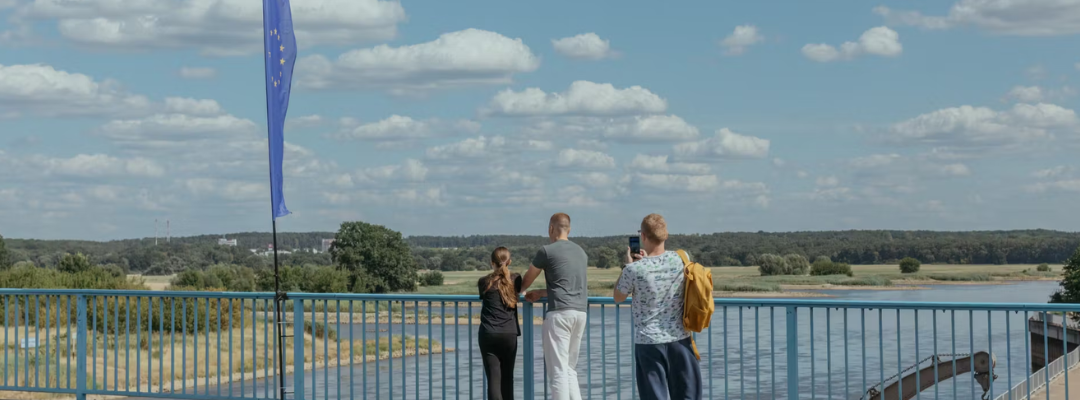
Germany reintroduced border checks in October 2023 as part of a migration crackdown, disrupting residents accustomed to the free movement Schengen had guaranteed since Poland's accession in 2007. In July 2025, Poland reinstated its own controls with no fixed end date. Logistics analysts warn the disruption could cost €1.1 billion annually in lost trade. However, the numbers tell only part of the story. Crossing the bridge last autumn, I began noticing something else. On the German side, AfD campaign placards had appeared on the railings. On the Polish side, national flags had been installed not by the city, but by the ROG (Ruch Obrony Granic Border Defence Movement), a far-right organisation founded in March 2025 by Robert Bąkiewicz, which ran self-directed citizen patrols at the border last summer. The move was legally calculated. Indeed, in Poland, national flags cannot be removed without risking prosecution for insulting a state symbol. When a German man tore down eight of them in July 2025, he was charged with a criminal offence. Every week, more flags are added, and none can be touched. A nationalist movement is using the law as a shield to claim territory, one flag at a time. The city of Słubice responded only last month by erecting a sign forbidding unauthorised items on the bridge, a rule the ROG has ignored with impunity.
Why should this alarm every European
This is not a local dispute. It is a symptom of a deeper structural problem in how Schengen is governed. The Schengen Borders Code permits member states to temporarily reintroduce internal border controls in the event of a serious threat as a measure of last resort, subject to strict time limits and mandatory notifications to EU institutions. In practice, the system has been stretched beyond recognition. As of October 2025, the Commission had recorded 481 notifications of temporary reintroductions. Germany's controls, first introduced in 2023, have been extended repeatedly, each time under the formal cover of 'exceptional circumstances' and each time for the same declared reasons. A measure that the framework designed as an emergency brake is being used as a gear. And crucially, the Commission can issue opinions, but it cannot force any member states to comply. The result is a zone of nominally passport-free travel where borders are, in practice, increasingly policed. If a region that spent thirty years as Europe's model of cross-border integration can drift back to controls and nationalist symbolism this quickly, the question is no longer whether Schengen is under pressure. The question is whether its founding logic that free movement within Europe is a right, not a privilege, still holds.
